
It is early November, the moving truck is booked for December, and the closet with every ornament you own is still untouched. Sound familiar? Holiday décor is one of the trickiest categories to pack because it mixes glass, wiring, and bulky shapes in one pile.
Here is how to pack holiday decorations for moving in short form: sort by type, wrap each breakable piece on its own, coil lights around cardboard, keep the tree in its original box or a tree bag, and label every box with its room and contents. The sections below walk through each step.
Sort Everything Before You Pack Anything
Sorting first saves you boxes, time, and heartbreak. Pull every decoration into one room and group it by type: ornaments, lights, garland and wreaths, tabletop pieces, outdoor items, and the tree itself.
This is also the best moment to downsize. If a string of lights has been dead for two seasons or a figurine lost its paint years ago, let it go now rather than paying to move it. A good rule is to keep what you actually put out last year, plus anything with real sentimental value.
Then split your pile into two groups. The first group is what you will use at the new place this season. The second is what can ride in the truck with everything else. Packing the first group last, so it comes out first, makes a December move much calmer.
Gather the Right Supplies
The right supplies turn a stressful job into a quick one. For most homes, this short list covers it:
- Packing paper or bubble wrap for fragile pieces
- Sturdy boxes in small and medium sizes, ideally with cardboard dividers
- Zip-top bags for hooks, caps, and small parts
- Cardboard sheets or empty tubes for winding lights
- Packing tape and a thick permanent marker
- A tree bag or the original tree box
Avoid packing everything in giant boxes. A heavy box of ornaments is a box of broken ornaments, since the bottom layer carries the weight of everything above it. Smaller boxes keep loads light and easier to handle on stairs.
How to Pack Fragile Ornaments Without Breakage
The simple answer: wrap each fragile ornament individually, pad the box, and never let two pieces touch. Glass, ceramic, and hand-painted ornaments need this treatment, because a single bump in a moving truck can crack them.
Start by removing the hooks and putting them in a labeled zip-top bag. Hooks can scratch glass and snag on tissue, and they are easy to lose.
Next, wrap each ornament in a sheet of packing paper or a small piece of bubble wrap. Fragile ornaments with long stems or delicate tops need an extra layer around the thinnest point, since that is where they usually snap.
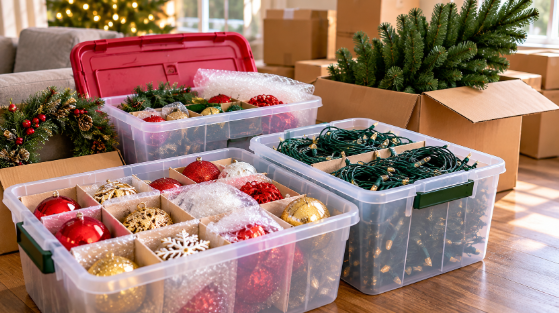
Place the wrapped pieces in a box with dividers, such as the cell boxes made for glassware. If you do not have dividers, line the bottom with crumpled paper, set one layer of ornaments in, add more paper, and repeat. Finish with a full layer of paper on top so nothing rattles when you shake the box gently.
A quick trick for heirlooms
For the pieces you could never replace, skip the shared box. Wrap each one, put it in its own small box, and write “Fragile – Keepsake” on every side. Many families move these in the car instead of the truck, and that is a reasonable choice.
How to Pack Soft and Sturdy Decorations
Soft décor such as felt stockings, tree skirts, and fabric ornaments can go in zip-top bags and then into a lined box. They also double as padding. Tuck a tree skirt or a throw blanket between layers of a box to protect harder items, and you save on packing paper at the same time.
Sturdy plastic or wooden ornaments need far less protection. A single sheet of paper per piece is usually enough. Keep them separate from the fragile boxes, so you never have to guess which box needs gentle handling.
How to Wrap Holiday Lights So They Do Not Tangle
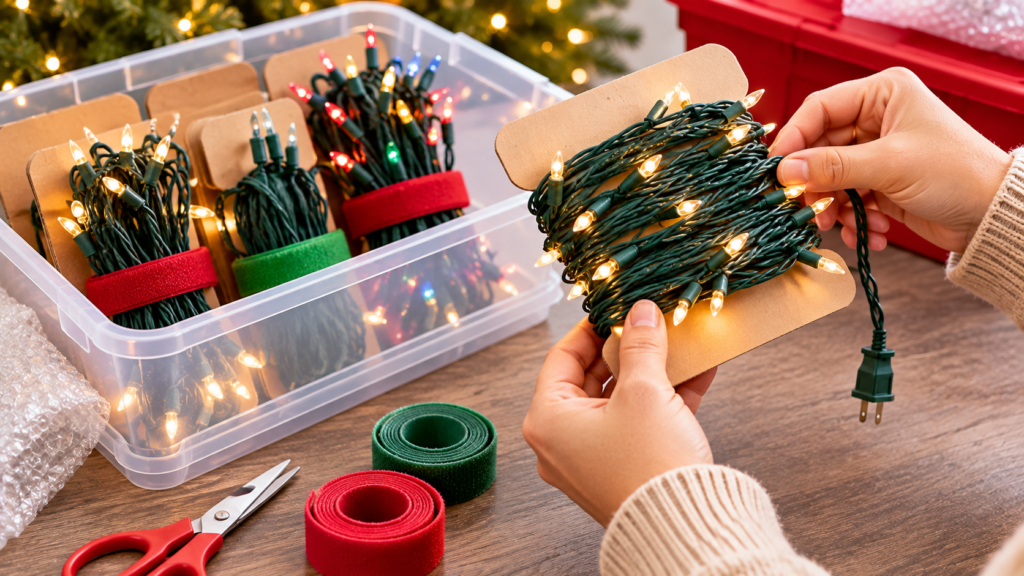
Coil each string around a piece of cardboard, an empty tube, or a spool, and tuck the plug end under the wraps so it cannot unwind. One string per piece keeps things simple, and you will not spend January untangling a knot.
Before you wrap, take a minute to inspect each set. The U.S. Consumer Product Safety Commission advises checking every set of lights, old or new, for cracked sockets, frayed or bare wires, and loose connections, and throwing out any set that is damaged. The agency estimated about 15,000 holiday decorating injuries were treated in emergency departments during November and December of 2012, so a quick check before storing is worth the effort.
Once the lights are wrapped, group them in one box or a shallow plastic bin. Put outdoor lights and indoor lights in separate containers and label them that way. If you use extension cords or timers, bundle them with the matching lights, so the whole setup is ready to go in one grab.
How to Store an Artificial Tree During a Move
Use the original box if you still have it. It was built to the tree’s exact shape, and it is the most reliable way to protect the branches. If the box is gone, a tree storage bag or a large, sturdy box with the sections wrapped in plastic wrap works well.
Follow these steps:
1. Remove all ornaments, hooks, ribbon, and any loose decorations.
2. Take the tree apart section by section, and check the manufacturer’s instructions if it is pre-lit.
3. Fold or compress the branches gently, and tie each section with a strip of soft ribbon or a Velcro strap.
4. Wrap sections in plastic wrap or place them in the tree bag, and keep the stand and screws in a labeled bag taped to the box.
5. Seal the box and mark it “this side up,” so it travels the right way.
Do not stack heavy boxes on the tree. The branches bend and the hinges can warp, and a flattened tree never fully recovers. Ask whoever loads the truck to place it near the top of the pile or against a wall.
Wreaths, Garland, and Outdoor Décor
Wreaths are best stored in a round wreath box or a wide, shallow box with the wreath lying flat. If you do not have one, wrap the wreath in plastic and place it in a box with paper stuffed around the edges. A wardrobe box with a hanging rod also works well.
For garland, remove any attached lights, fold it loosely in lengths, and secure it with a few rubber bands. Pressing it into a tight bundle bends the wire and flattens the needles.
Outdoor pieces such as inflatables, yard stakes, and plastic figures should be dry and clean before packing. Mud and moisture can mold in a sealed box, and nobody wants that in a new garage. Put them in plastic bins with latching lids if you are moving a long distance.
How to Label Holiday Boxes So Unpacking Is Easy
Label each box on at least two sides with three things: the holiday, the room it belongs to, and what is inside. “Christmas – Living Room – Gold Tree Ornaments” tells you far more than “Holiday Stuff.”
A few small habits help:
- Mark fragile boxes clearly and keep them together.
- Number boxes that belong to one display, such as “Mantel 1 of 3.”
- Tape a short packing list inside the lid of larger boxes.
- Use a colored sticker for anything you need before the rest of the move is unpacked.
Keep holiday boxes with other holiday boxes. Mixing a wreath with picture frames or kitchen items makes everything harder to find when the truck is unloaded.
What to Do If You Are Moving in the Middle of the Season
If you are moving in November or December, you are not alone. The Census Bureau reports that about 40 million people, or roughly one in eight, changed homes in 2023, and plenty of those moves land close to the holidays. A mid-season move simply needs a bit more planning.
Pack the décor you are not using first, and leave out a small “decorate first” box with a string of lights, a few favorite ornaments, a tabletop tree, and a stocking for each person. Carry that box yourself so it never gets buried on the truck.
Start at least two to three weeks before moving day. Spread the work across a few evenings, so you are sorting one night, wrapping ornaments the next, and handling the tree and outdoor items last. Rushed packing is the main reason ornaments break.
If the schedule is truly tight, getting professional packing and unpacking services for the fragile boxes is one option, and it frees you to handle the sentimental pieces yourself. Even then, do your own sorting and labeling first, since you know best what each box means to your family.
Frequently Asked Questions
What is the best way to pack Christmas ornaments for a move?
Wrap each ornament separately in packing paper or bubble wrap, then place it in a small box with dividers or padded layers. Keep hooks in a separate bag. Fill every gap with crumpled paper so nothing shifts, and label the box as fragile before sealing it.
How do I pack an artificial Christmas tree for moving?
Use the original box if you have it. Otherwise, take the tree apart, remove all decorations, and wrap each section in plastic or place it in a tree bag. Tie branches gently, keep the stand and screws in a labeled bag, and avoid stacking heavy items on top.
How do I keep Christmas lights from tangling in a move?
Wind each string around a piece of cardboard, a tube, or a spool, and tuck the plug end into the wraps. Store the strings in one bin or box instead of loose bags. Inspect each set first, and discard any with cracked sockets or frayed wires.
Should I pack holiday decorations first or last?
Pack off-season décor first and the items you will use this season last. If you are moving during the holidays, set aside a small box of essentials, such as lights, a few ornaments, and a tabletop tree, and carry it with you rather than loading it on the truck.
How early should I start packing holiday decorations?
Start two to three weeks before moving day. That gives you time to sort, downsize, collect supplies, and wrap fragile items without rushing. Rushed packing leads to broken ornaments and mislabeled boxes, so spreading the work over several evenings is the safest approach.
A Smoother Move Starts With Small Boxes
Holiday décor does not need to be a headache. Sorting first, wrapping fragile pieces one at a time, coiling lights, and labeling every box with its room and contents covers most of what goes wrong.
Put a little extra thought into the items that matter most. Keep your keepsake ornaments close, protect the tree’s shape, and carry a small box of seasonal favorites yourself. When the first string of lights goes up in your new home, you will be glad you did.